
Dod yn fuan!! \\ Coming soon!! Mexico: Dulce suenos, Mountain water DECAF
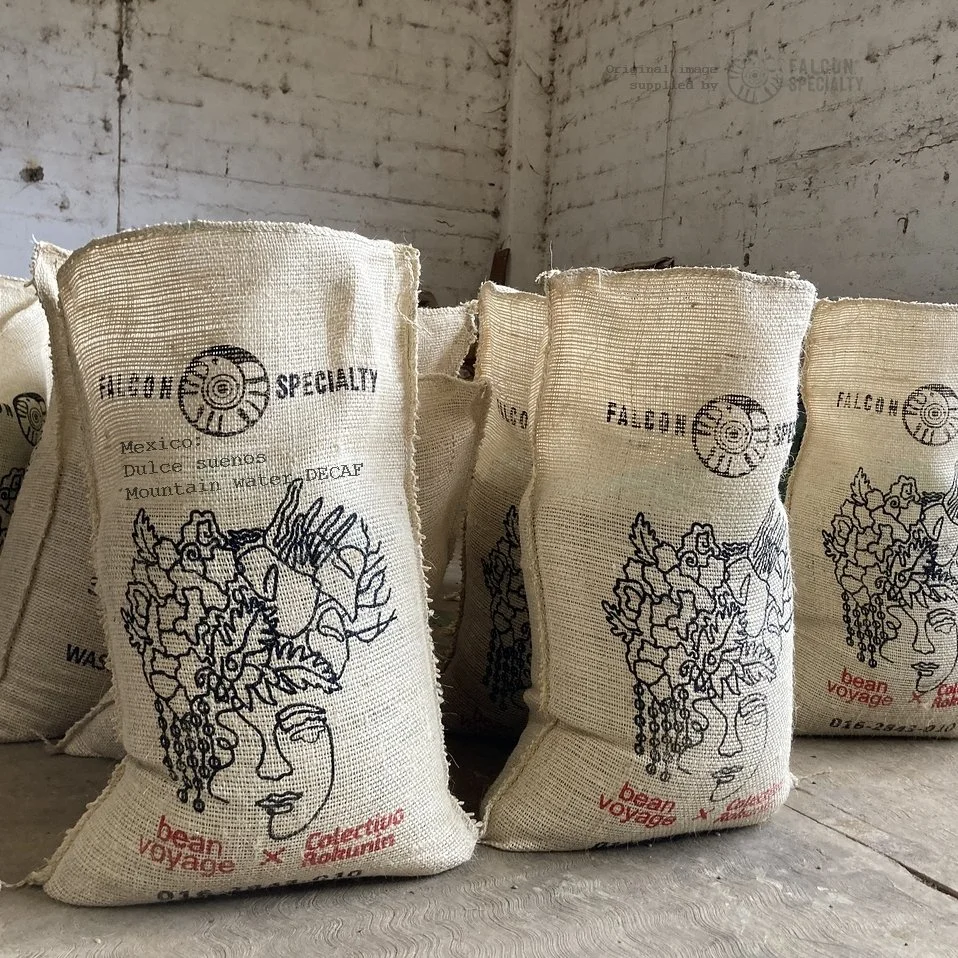
Dod yn fuan!! \\ Coming soon!! Mexico: Dulce suenos, Mountain water DECAF
Tasting notes: Cocoa, Yellow apple, Orange and Sugar cane.
Nodiadau blas: Cocoa, Afal melyn, Oren a Cansen siwgr.
Prior to DECAFFIENATION this coffee was produced by Café 89 an organisation of women coffee producers in the Frailesca region of Chiapas, where coffee grows 1200-1900masl on the slopes of the Sierra Madre de Chiapas at around Jaltenango and the El Triunfo Biosphere Reserve. The varietals in this blend are Typica, Bourbon, Geisha, Peñazco which then goes through a washed process.
Cyn DIDDASGAFFEINIO cynhyrchwyd y coffi hwn gan Café 89, sefydliad o gynhyrchwyr coffi benywaidd yn rhanbarth Frailesca yn Chiapas, lle mae coffi'n tyfu 1200-1900masl ar lethrau Sierra Madre de Chiapas o gwmpas Jaltenango a Gwarchodfa Biosffer El Triunfo. Y mathau yn y cymysgedd hwn yw Typica, Bourbon, Geisha, Peñazco sydd wedyn yn mynd trwy broses golchi.
Café 89 is an organisation of women coffee producers in the Frailesca region of Chiapas, where coffee grows on the slopes of the Sierra Madre de Chiapas around Jaltenango and the El Triunfo Biosphere Reserve. Coffee in the area is grown mainly by smallholders, and the harvest broadly runs from December to March.
The initiative began in 2018 with the aim of creating a legal entity that would give women coffee producers greater empowerment and open better market opportunities, both within Mexico and abroad. Its logo, the 89 butterfly, honours the 89 women who first formed the group. For its members the butterfly stands for the natural, the feminine and continuous evolution within the coffee supply chain. After a period of organising and dialogue, the group was formally constituted on 8 August 2022 as CAFÉ 89 SPR de RI.
Today Café 89 has 124 women producers, 53% of them young women aged between 19 and 39. Together they farm 407 hectares, with production of approximately 338.24 metric tonnes, across the municipalities of Capitán Luis Ángel Vidal, Montecristo de Guerrero, Ángel Albino Corzo, La Concordia and Villa Corzo.
This lot was decaffeinated by Descamex (Descafeinadores Mexicanos) at its plant in Córdoba, Veracruz, using the company's Mountain Water Process. Descamex was founded in 1980 as the first decaffeination plant in Latin America, and its water extraction process was patented in 1987. The coffee is first analysed to determine the optimal extraction conditions, then steamed to prepare the beans for extraction. Caffeine is extracted under controlled flow, temperature, pressure and vacuum, using a water-based solution saturated with soluble solids obtained from green coffee, and is then filtered out of the solution. No chemical solvents are used. After extraction the coffee is dried gently in a triple drying system and finally polished. Descamex states that the process removes more than 98% of the caffeine.
The organisation describes a range of operational, logistical and social challenges in the region. Insecurity limits visits from clients and financiers and makes it harder for the producers to travel safely. Internet and electricity supply fail on a recurring, monthly basis. The producing areas are remote, which leaves gaps in communication with members. Finance is a constant need: Café 89 requires enough credit, available in time, both to fulfil its contracts with clients and to collect more than 80% of its members' coffee.
Bean Voyage, a Costa Rica-based nonprofit that works with smallholder women coffee producers in Latin America on training, seed funding and market access, has supported the group. Café 89 describes its participation as transformative, less a training programme than a space for empowerment. Bean Voyage provided market knowledge, helped the group look for clients and export its coffee to other countries, and gave members the chance to share experience with other women producers through the Women-Powered Coffee Summit and the Farmer School. "Above all, they have given us confidence and a voice," the cooperative says. Members say they now understand the value of their coffee better and feel prepared to negotiate and to tell their own story. With the 2026 harvest, Bean Voyage facilitated the group's first exports to the United States and Japan, connecting it with potential international buyers. It also awarded a scholarship for representatives of Café 89 to attend a coffee festival in Busan, South Korea, where they presented the producers' work and led guided cuppings with prospective Korean buyers and roasters.
Looking ahead, Café 89 aims to maintain and strengthen a solid, profitable cooperative that leads in coffee shop services and agribusiness, and to ensure that each member's coffee earns a higher commercial value. Many of the members are heads of household, and a better price lets them directly improve their families' quality of life. The organisation plans its growth in line with the environment, social responsibility and gender equity. Its dream, in the cooperative's words, is "that the coffee of Jaltenango is recognised for its quality around the world, and that this recognition translates into a dignified life for our families." Members hope their children will be able to study, that women producers will take a greater part and more leadership in the coffee chain, and that they can go on conserving their forests for future generations. They look for stability, fair prices and long-term relationships with buyers who value the origin and the work of each producer, and want Café 89 to endure as a sustainable, united association that raises the standing of coffee from Chiapas.
For the members, coffee is identity, evolution, empowerment and the livelihood of their families. It represents the hard work of women who look after quality from the plot onwards, and a means of changing their lives, caring for the environment of Chiapas and reaching beyond its borders.
Details provided by Falcon Speciality