
Nicaragua: Dulce Suenos - Papagayo, Aldea Coffee Sparkling water Decaf
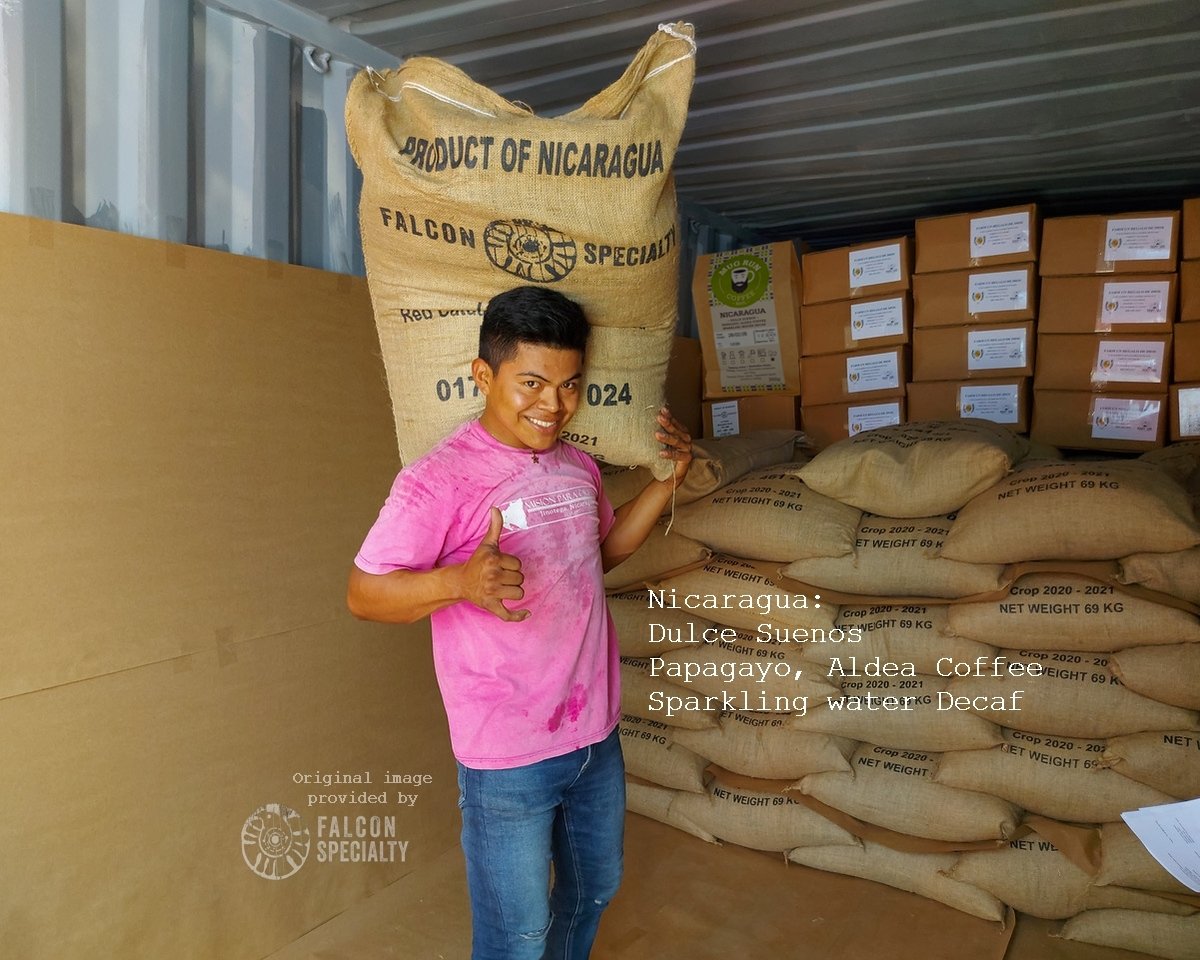
Nicaragua: Dulce Suenos - Papagayo, Aldea Coffee Sparkling water Decaf
Tasting notes: Caramel, Peanuts, Chocolate milkshake and Pear.
Nodiadau blasu: Caramel, Cnau daear, Ysgytlaeth llaeth siocled a Gellyg.
These Caturra, Catuai, Panainema and Catimore varietals are shade grown by the Aldea cooperative which has 20,000 small holders situated between 1100-1300 masl in the highlands of Jinotega region within the Café ECOFORESTAL program an agroforestry system that uses interplanting to improve revenue streams and enhance soil health.
Mae'r mathau hyn o Caturra, Catuai, Panainema a Catimore yn cael eu tyfu mewn cysgod gan y cwmni cydweithredol Aldea sydd â 20,000 o ddeiliaid bach wedi'u lleoli rhwng 1100-1300 mulm yn ucheldiroedd rhanbarth Jinotega o fewn y rhaglen Café ECOFORESTAL, system agroforestry sy'n defnyddio rhyngblannu i wella ffrydiau refeniw a gwella iechyd y pridd.
This shade-grown Arabica coffee originates in the highlands of Jinotega, Nicaragua, where more than 20000 smallholder members of the Aldea Coffee cooperative—5229 of them women—farm an average of five hectares each under a model first organised in 1992 to advance environmental stewardship and rural credit for coffee growers.
Cultivation takes place between 1100 and 1300 metres above sea level within the Café ECOFORESTAL programme, an agroforestry system that integrates hardwood and fruit trees, banana plants and cover crops to diversify income streams and enhance soil health. Ripe cherries are selectively hand-picked from December to March, sun-dried at the Asturias processing facility, and prepared for export during the November–June shipping window, ensuring consistent quality and moisture control.
The lot is graded to screen sizes 15–20 and comprises Caturra, Catuaí, Parainema and Catimore varieties. Certified production for the 2025 crop year totals 41,327 bags (69 kg each) drawn from 321 farms, while overall exports by the cooperative’s marketing arm are projected to reach 200 750 bags.
Compliance with Rainforest Alliance, Fairtrade USA, Organic and With Women’s Hands standards underscores the group’s commitment to sustainable land management, equitable trading terms and gender-inclusive governance. Following a 2023 organisational restructure, export services are managed by Aldea Coffee S.A., one of four specialised entities created to strengthen farm finance, input supply and community investment for members across the Jinotega region.
THE SPARKLING WATER DECAFFEINATION PROCESS:
This process was first discovered by a scientist called Kurt Zosel at the Max Planck Institute for Coal Research in 1967 as he was looking at new ways of separating mixtures of substances. In 1988, a German decaffeination company called CR3 developed this process for decaffeination whereby natural carbon dioxide (which comes from prehistoric underground lakes) is combined with water to create sub-critical conditions which creates a highly solvent substance for caffeine in coffee. It is a gentle, natural and organically certified process and the good caffeine selectivity of the carbon dioxide guarantees a high retention level of other coffee components which contribute to taste and aroma.
The process is outlined below:
The green beans enter a pre-treatment vessel where they are cleaned and moistened with water before being brought into contact with pressurised liquid carbon dioxide. When the green coffee beans absorb the water, they expand and the pores are opened resulting in the caffeine molecules becoming mobile.
After the water has been added, the beans are then brought into contact with the pressurised liquid carbon dioxide which combines with the water to essentially form sparkling water. The carbon dioxide circulates through the beans and acts like a magnet, drawing out the mobile caffeine molecules.
The sparkling water then enters an evaporator which precipitates the caffeine rich carbon dioxide out of the water. The now caffeine free water is pumped back into the vessel for a new cycle. This cycle is repeated until the required residual caffeine level is reached. Once this has happened, the circulation of carbon dioxide is stopped and the green beans are discharged into a drier. The decaffeinated coffee is then gently dried until it reaches its original moisture content, after which it is ready for roasting.
There are several benefits to using this process for decaffeination:
The agent used for extracting the caffeine is entirely natural and the process can be classified as organic due to the complete lack of chemicals used throughout. There is also no health risk by consuming coffee that has been decaffeinated in this way. The way the process works means the other compounds in the green bean are left untouched, meaning decaffeination has no effect on the flavour and aroma of the finished product. The carbon dioxide is very selective and doesn’t extract the carbohydrates and proteins in the green bean which contribute to flavour and smell.
The cell structure of the green bean and the finished roasted bean is unchanged which is of great advantage when working with speciality coffees.
The by-products are 100% natural and recyclable.
Details provided by Falcon Speciality